
UNESCO Heritage in Northern Portugal: Places Not to Miss

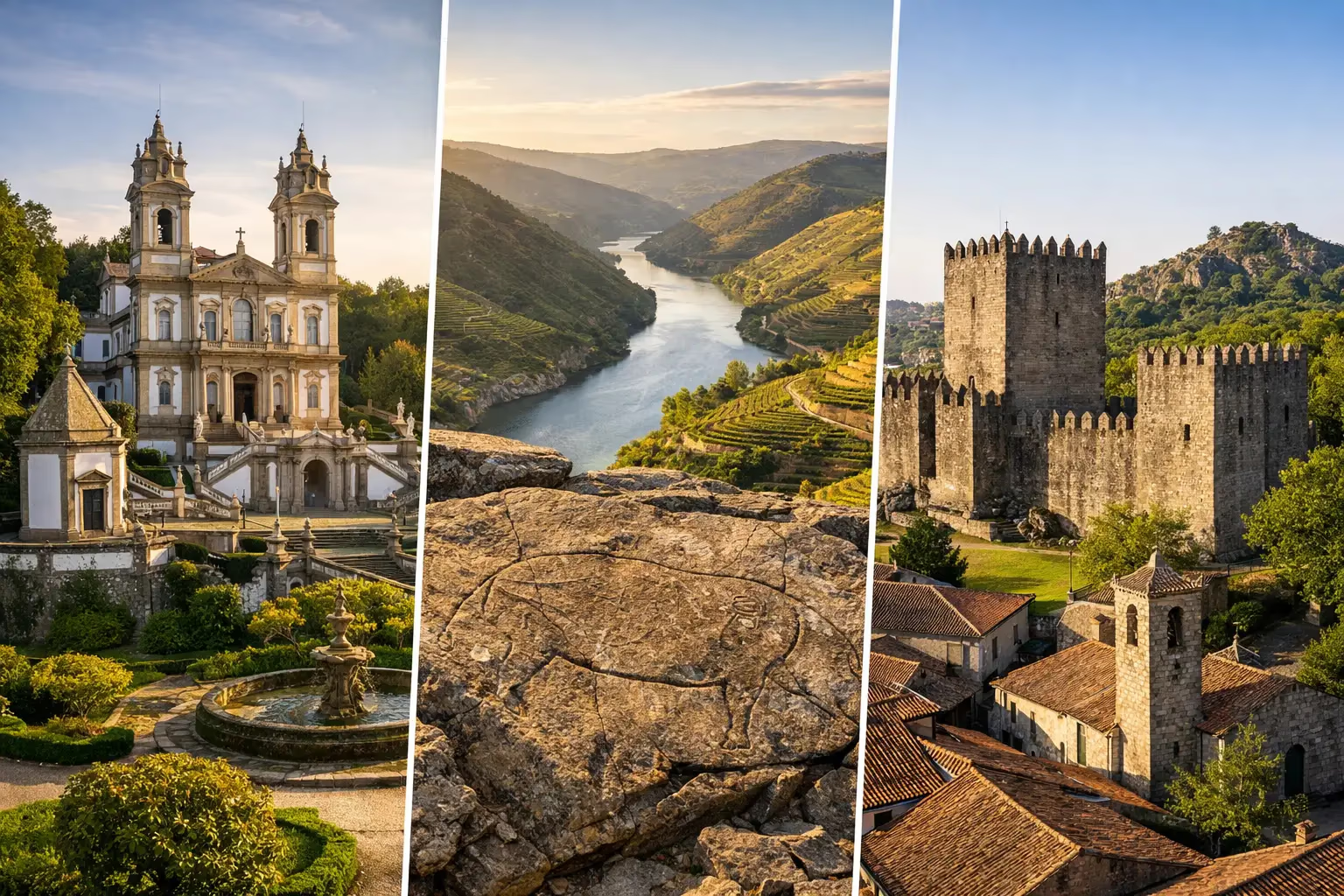
UNESCO heritage in Northern Portugal is not confined to museums nor limited to a single city. It appears in a Baroque staircase overlooking Braga, in Guimarães' granite alleys, in the terraces of the Douro, on Porto's façades, and in the prehistoric engravings of the Côa Valley. It is a region to explore with time, context, and room to look.
For those setting out from Porto and looking for a private experience, the choice should not be only between destinations. It should begin with the right question: do you prefer urban history, religious architecture, wine and landscape, or a more remote encounter with the origin of human presence in the territory? Every UNESCO-listed place offers its own pace and deserves a visit planned to suit you.
The five UNESCO sites in Northern Portugal
The North brings together five inscriptions on the UNESCO World Heritage List. Although they may appear on the same travel itinerary, they should not be treated as a simple checklist of places to tick off. Each one reveals a distinct layer of Portuguese identity: the making of cities, the formation of a nation, the relationship between humankind and the vine, spirituality, and the oldest memory of the Douro Valley.
Porto Historic Center
Listed in 1996, the Porto Historic Center is a lived-in, sloping city shaped by the river. From the Cathedral to Ribeira, from narrow stairways to the banks of the Douro, its importance does not depend only on isolated monuments. It lies in urban continuity, in the mix of housing, commerce, churches, viewpoints, and old river connections.
A well-guided visit goes beyond the images of the Dom Luís I Bridge. It makes it possible to understand how Porto grew between medieval walls, how Atlantic trade shaped the city, and why Vila Nova de Gaia, on the opposite bank, became inseparable from the history of Port wine. The best time to get to know this area varies: in the morning, the light is calmer and there are fewer people; late in the afternoon, the façades over the river take on a special presence, although the best-known areas are busier.
Historic Center of Guimarães
Guimarães was inscribed in 2001 and maintains a rare coherence between its medieval past and contemporary life. The squares, wooden balconies, granite buildings, and narrow streets are not a reconstructed set. They form a historic center where the human scale invites you to walk unhurriedly.
The city is deeply tied to the founding of Portugal, but it is worth avoiding a rushed visit focused only on the Castle and the Dukes' Palace. Its charm is also found in Largo da Oliveira, São Tiago Square, and the small details of an urban fabric preserved over the centuries. For travelers who value culture, cuisine, and a more intimate atmosphere than Porto, Guimarães is a particularly rewarding choice for a full day.
Douro Wine Region
The Douro Wine Region, listed in 2001, is one of the most expressive examples of a cultural landscape in Europe. It is not just a wine-producing region. It is the result of generations turning steep slopes into terraces, building schist walls, and working in a demanding balance with the river and the climate.
The terraces are impressive in any season, but they change a great deal throughout the year. In spring, the valley reveals intense green tones; in summer, the light brings out the relief and the schist; during the harvest, activity at the estates takes on a different energy; in autumn, the vineyards create a golden and copper palette. The ideal time depends on what you want to feel, not just photograph.
The Douro calls for careful choices. A wine tasting at a historic estate, a regional lunch overlooking the vineyards, a short cruise on a traditional boat, or a walk between villages can all be part of the same day. But trying to fit everything in reduces the quality of the experience. A private itinerary allows you to favor two or three experiences and reserve time for spontaneous stops at the best viewpoints.
Prehistoric Rock Art Sites in the Côa Valley
On the banks of the Côa, near its confluence with the Douro, there are thousands of open-air engravings that date in part to the Upper Paleolithic. The UNESCO designation, awarded in 1998, recognizes an extraordinary set of representations of horses, aurochs, goats, and other animals, engraved in rock more than 20,000 years ago.
This is the most demanding UNESCO heritage site in the North in logistical terms, but also one of the most striking. The distance from Porto makes it difficult to include in a conventional day, especially if the intention is to visit the museum and the rock-art areas at a relaxed pace. It makes more sense as an extension of a trip through the Upper Douro or as a two-day program, combining heritage, landscape, and local accommodation.
The visit requires booking and organization, since access to the sites is controlled to protect a vulnerable heritage. That limitation is part of its value: instead of crossing an overcrowded space, the visitor approaches the engravings in a context of silence, scale, and respect for the place.
Sanctuary of Bom Jesus do Monte, Braga
Listed in 2019, the Sanctuary of Bom Jesus do Monte represents a singular vision of religious architecture and landscape. The monumental staircase, arranged in landings and allegorical fountains, leads to the sanctuary through a route designed as a spiritual, scenic, and physical experience.
There are several ways to reach the top, and each one changes the experience. Climbing the staircase allows you to appreciate the Baroque composition step by step; using the hydraulic lift, one of the oldest still in operation in the world, adds a historical dimension; arriving by vehicle offers comfort, but removes part of the dramatic progression of the whole. For many visitors, the best solution is to go up by funicular and come down on foot, with time to enjoy the gardens and the view over Braga.
How to choose the best itinerary
Proximity on the map can be misleading. Porto, Braga, and Guimarães work well together on a cultural route, but trying to visit all three historic centers in a single day turns the trip into a succession of stops. For a more complete experience, it makes sense to dedicate one day to Porto and another to Braga and Guimarães, choosing the moments that really matter to each group.
The Douro calls for a different approach. The journey from Porto is an essential part of the program, especially when it includes scenic roads, viewpoints, and selected estates. For couples and small groups, a private day makes it possible to combine wine, cuisine, and landscape without depending on the schedules of large groups or standardized stops.
The Côa, in turn, rewards those who are willing to travel farther. It is the right choice for visitors who already know the North's more obvious places and are looking for a deeper connection to the territory. It is not an experience to be squeezed in between wine tastings or city visits: it is a destination with its own gravity.
Visiting heritage with more meaning
Traveling through UNESCO sites also requires attention to how they are visited. In urban centers, this means respecting those who live in the historic streets, choosing local businesses, and avoiding treating residential neighborhoods as scenery. In the Douro, it means recognizing that the admired landscape was shaped by continuous agricultural work and that the estates are not just tasting venues, but living farms.
A premium experience should not mean distance from the destination. On the contrary, it should create the right conditions to understand it better: comfortable transport, flexible pacing, local knowledge, and access to places chosen for their authenticity. On a private trip with VIDABOA TOURS, personalization makes it possible to balance the icons that justify the journey with less obvious details, such as a road through the vineyards, a regional meal, or a viewpoint without crowds.
The North does not ask you to see everything. It asks you to choose well. By setting aside time for one place, listening to its history, and feeling its landscape, heritage stops being a classification on a map and becomes a memory that stays with you long after you return.